What’s an AI Harness?
A Practical Guide for Startups & Small Businesses
And scroll down to see our handy infographic!
AI adoption is no longer the hard part. Trusting the output is. If your team is using AI to draft, summarize, or decide, an AI harness is the piece most companies are still missing.
What is an AI Harness?
An AI harness is a structured system of guardrails, checks and monitoring wrapped around an AI model, controlling outputs before they can reach a person, customer or filing. The model still does the work. The harness decides whether that work is ready to leave the building.
Think of it like scaffolding on a construction site: the AI does the building, and the harness keeps everything aligned, inspected, and safe before anyone relies on it.
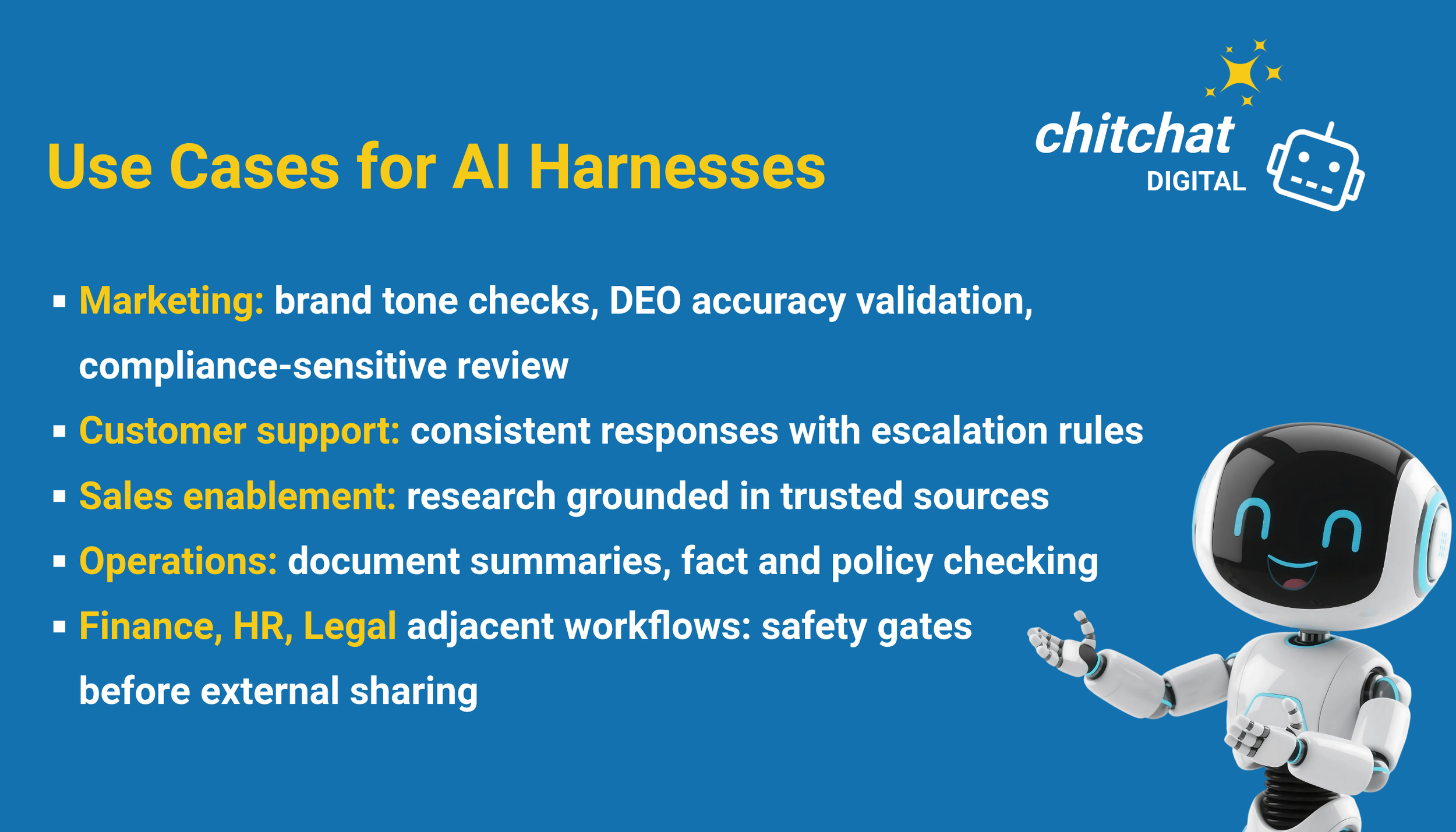
AI Harnesses can be applied across multiple business functions to increase productivity.
How does an AI Harness work?
Most harnesses have four layers:
validation rules that define acceptable outputs
fact-checking against trusted company sources (your policies, pricing, and documentation)
confidence scoring that flags shaky answers
human review checkpoints for high-stakes content, such as contracts, medical information, technical test results, legal filings, etc.
AI Harness Importance, Implementation and Expense
AI Harnesses are important because AI models are confidently… wrong, a LOT of the time. Harvard Business Review notes, “inaccurate or unexpected results, whether GenAI hallucinations or errors in text-based results, and embedded bias are among the top concerns curtailing business executives’ trust in AI.” (1) A hallucinated citation, a made-up product spec or invented refund policy can wreak havoc on your bottom line and reputation. They’re not hard to implement, because the first version isn’t about software, it’s about documented workflows: what gets checked, who is checking it, and what never ships without being reviewed. Add automation as volume grows. And as for expense, your first harness costs process, not budget. A small team can get useful protection from a written review standard and a checklist. Commercial verification and monitoring tools do exist, and their costs scales with usage and risk level.
Business Use Cases for AI Harnesses for Startups and Small Businesses
AI harnesses can be applied across functions, such as:
Marketing: content drafts with brand tone checks, SEO accuracy validation, and compliance-sensitive review.
Customer support: consistent responses supported by a knowledge base, with escalation rules.
Sales enablement: lead research grounded in trusted sources and approved messaging.
Operations: document summarization with fact-checking and policy checks.
Finance, HR, legal-adjacent workflows: safety gates before any external sharing or decision support.
The bottom line: AI Harnesses help teams gain speed without sacrificing reliability, improving quality, reducing hallucinations, strengthening credibility, and supporting safer AI adoption. The World Economic Forum reports that organizations with “responsible AI guardrails” built in from the start can “proceed more quickly during final deployment and scaling efforts…”. (2)
Check out our handy infographic all about AI Harnesses
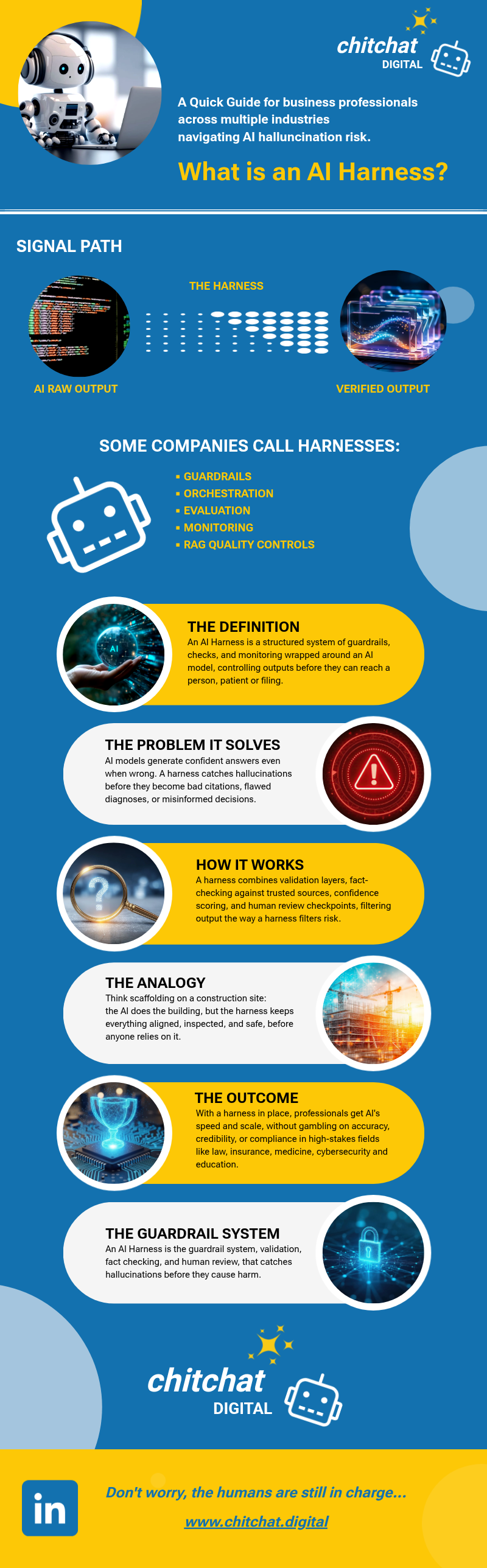
You can also download a PDF of this infographic here.
Need help with marketing strategy and content? #LetsChitChat
Need help with AI training? We’re also Certified Partners with The Kendall Project.
Authored by CMO Melissa Daley
SOURCES
(1) https://hbr.org/sponsored/2024/09/ai-has-a-trust-problem-heres-how-to-fix-it
FAQs
What's the difference between an AI harness and an AI guardrail?
A guardrail is a single rule, like blocking a model from discussing pricing. A harness is the whole system: the rules, the fact-checking, the confidence scoring, and the human review checkpoints working together. Guardrails are components. The harness is the architecture around them.
Do I need an AI harness if my team only uses ChatGPT or Copilot?
Yes. Consumer AI tools have no knowledge of your pricing, policies, or client commitments, so nothing stops a confident wrong answer from reaching a customer. Your harness is the review workflow your team follows before that output ships, regardless of which model produced it.